Stretching
Static Flexibility
Static flexibility is flexibility which does not involve movement. It is a measure of the full range of motion of a joint and its related muscular involvement. The measure of progress in a side split or toe touch are classic examples of gauging the static flexibility of the relevant muscle groups. There are two types of Static Flexibility; Static Active and Static Passive.
Static Active Flexibility
Static active flexibility refers to the ability to maintain a position of an extended range of motion while stretching the antagonist muscles using only the tension of the agonistic and synergistic muscles for support. The ability to assume and hold the stretched position comes solely from your muscles. The static active flexibility is dependent upon the static passive flexibility in combination with the static strength of the stabilizing muscles. An example of a static active flexibility is the ability to stand on one leg while you raise and hold the other leg out in front of you without any other external support.
Static Passive Flexibility
Static passive flexibility refers to the ability to maintain an extended position using some external force. The external force could be your weight, your arms and hands, some apparatus or a partner. The ability to assume and hold the stretched position does not come solely from the muscles of concern as in static active flexibility. An example of static active flexibility is the side split with the force of gravity aiding the range of motion.
Dynamic Flexibility
Dynamic flexibility concerns motion and the ability to perform movements of a limb or body part through its joint’s full range of mobility. Dynamic flexibility depends on the body’s ability to combine relaxation of the agonistic muscles along with contraction of the antagonistic muscles in a dynamic motion. Dynamic flexibility is the type of flexibility that typically increases performance of a martial art. The ability to kick high with power or fluidly perform a block with an extended range of motion are dependent upon dynamic flexibility. An example of Dynamic Flexibility is the ability to perform a high side kick.BJC Gladiators Plyometrics Exercises
Phase I - Upper Body
1. Standing
partner piston pumps
2. Half push ups (ie. Chinese press ups on knees)
3. Bicep Curls (Laying down - use of partner)
4. Tricep dips (partner supported)
5. Full push ups by the count
Phase II - Mid-Section
1. Crunches
(lying down - knees bent)
2. Left side crunches (Lying down - one knee bent)
3. Right side crunches (Opposite knee bent)
4. Double torso curls
5. Reverse torso curls by the count
Phase III - Lower Body
1. Sprints (Alternating touch downs)
2. Heel kicks to rump (Both heels)
3. Knee lifts to chest (Both knees)
4. Half squats (Elbow to knees)
5. Wide stance squats by the count (Parallel Thighs)
The Tabata Protocol
Created by Izumi Tabata, the original Tabata Protocol requires the following:
- 5 minutes of warm-up
- 8 intervals of 20 seconds all-out intensity exercise followed by 10 seconds of rest
- 2 minutes cool-down
The entire beginner workout starts out at 7 minutes long. It breaks down to 3 minutes of warm up, 2 intervals of 30 seconds each. (1 minute of exercise) followed by a 2 minute cool-down.
Warm up for 3 minutes at a moderate pace. You can start out with a low resistance and low RPMs (like 60-65 RPMs on a bike) for the first minute, increase the tension on your equipment one notch for the second minute, then increase the RPMs to 70-75 RPMs and/or tension for the last minute, gradually raising your heart rate to a moderate level.First, increase the tension one notch above where your warm up ended at, or more if you find your feet are flying off the pedals
Pedal (or go) FULL SPEED, as fast as you can, well above 85 RPMs (if on a bike) - even over 100 RPMs - for 20 seconds.
Pedal slow for the next 10 seconds. If you did it right, you SHOULD see your Heart Rate go UP a little AFTER you stop pedalling so fast. This is because of the Oxygen Debt you created, and it signals your body to get more oxygen to your energy system. You will notice yourself panting - this is your body trying to get more oxygen to your lungs to fuel your energy system.
Repeat 1 more time (20 seconds all out fast, 10 seconds slow). Notice your Heart Rate go up a little after you enter the slow part of the interval each time.
After 2 intervals, decrease the tension to 0 (lowest setting) on your bike or other equipment and pedal slow for 2 minutes.
After your 2 minute cool-down, stop pedaling COMPLETELY for 1 minute and just sit there.
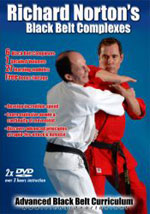 |
Richard Norton is considered to be one of the most successful Martial Artists in the world with over 45 years training and a movie career spanning some 30 years with over 60 feature films along-side such greats as Jackie Chan and Chuck Norris. NOW for the first time YOU can learn Richard's favorite 'Black Belt Complexes' - a curriculum of advanced training drills for developing explosive speed and power for you, the advanced Martial Artist. Norton has mastered many aspects of the Martial Arts including Judo, Karate, Jiu Jitsu, Aikido, Muay-Thai Kick Boxing and various Japanese weapons systems. He has trained extensively with such Martial Arts legends as Tino Ceberano, Tadashi Yamashita, Benny' The Jet' Urquidez, Fumio Demura, Bill Wallace, Pete 'Sugar Foot' Cunningham, the Machado's and Chuck Norris. |
Dave ‘The Rock’ Hedgcock presents his unique style of pad work, boxing & kickboxing techniques that have delivered multiple Australian & World Champions. Dave Hedgcock was ranked number 1 in the world for four years with a record of 78 fights and only 3 losses. In Hedgcock Angles Volume 1 Dave teaches his unique system of angles, combinations and power punch and kick techniques in an easy to follow format. You will gain valuable insight and instruction into the techniques that have made Dave Hedgcock a household name and internationally renowned trainer. Dave has trained Australian and World Champions including Lester Ellis, Sam Soliman, Maurice Smith, Tosca Petridis, Alex Toohey, Dana Goodson, Stan ‘The Man’ Longanidis to name but a few. |  |
